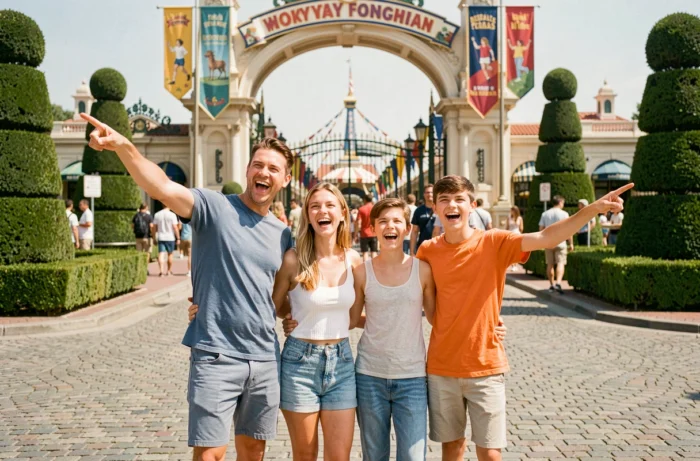
France boasts a variety of amusement parks that goes beyond the often-highlighted duo of Disneyland and Astérix. Historical show parks, interactive science sites, water complexes, or themed areas designed for little ones: the choice depends as much on the children’s age as on the type of experience sought. Understanding what distinguishes each category of park helps avoid a poorly calibrated day, too intense for the youngest or too tame for teenagers.
Levels of thrills and age groups: the criterion families underestimate
A successful family amusement park hinges on a parameter rarely displayed clearly: the match between the thrill level and the age of the group. Taking a four-year-old to a park designed around high-intensity roller coasters guarantees frustration and unnecessary waiting lines.
Some parks now segment their offerings by tiers. Parc Astérix, for example, classifies its seasonal experiences (notably for Halloween) into three levels: “little thrill,” “moderate fright,” and “big terror.” A “monster-repelling” badge is even offered for free to visitors wishing to avoid interactions with scary characters. This type of arrangement radically changes the experience for a family with children of different ages.
Before booking, it’s useful to check the minimum height requirement for each major attraction. A park that offers several rides accessible from one meter (like the family roller coaster Cétautomatix at Parc Astérix) will be more cost-effective than a site where half the attractions are off-limits to those under seven. To explore 1 maman blogueuse online, an interactive map helps locate parks by region and family profile.
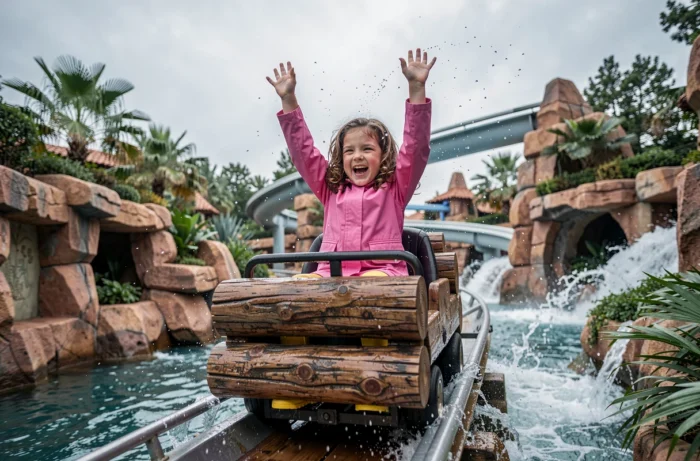
Show parks in France: when the show replaces the rides
Not all amusement parks rely on rides. Show parks constitute a distinct category, often better suited for families with young children or grandparents accompanying the group.
Puy du Fou, in Vendée, operates entirely on this model. Historical reenactments (Roman circus games, knightly jousts, period villages) fill the day without requiring a waiting line comparable to that of a ride. The Cinéscénie, an evening show, completes the day, but chaining it with the daytime park requires real physical endurance, especially with children.
Futuroscope, in Vienne, combines immersive shows and interactive technologies. Its scientific and educational orientation makes it a relevant choice for curious children from six years old. The park is also preparing for the opening of the retro-futuristic hotel Utopia, announced for December 2027, with a large-capacity restaurant, signaling a desire to transform the visit into a multi-day stay.
Why prioritize a show park with children under six
Shows eliminate the constraint of minimum height. A three-year-old can attend a historical reenactment or an aquatic show without restriction. The pace is also more flexible: families choose their schedule, intersperse meal breaks, and do not feel the pressure to “get their money’s worth” from a ride pass.
Recent investments in major French amusement parks
The landscape of amusement parks in France is evolving quickly. The investments announced in recent years are changing the offerings available for families and deserve consideration before planning an outing.
- Parc Astérix has announced an investment plan of 250 million euros, including new themed areas, additional attractions, and a hotel. The indoor area Londinium, inspired by Asterix in Britain, is planned for 2028.
- Futuroscope is focusing on immersive accommodation with its Utopia hotel project, integrating spaces for professional events in addition to family hospitality.
- The Festival Toutatis area at Parc Astérix alone represents an investment of 36 million euros, with a clear family orientation.
These figures reflect an underlying trend: French parks are shifting from the “single day” model to immersive stays. For families, this means increasingly competitive hotel-park offers and sites that justify two days of visit rather than just one.
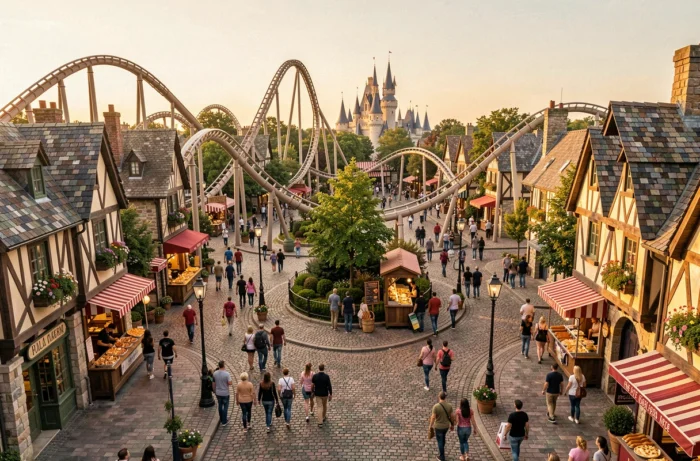
Well preparing a day at an amusement park with children
The success of a family outing to a park does not only depend on the choice of site. The day and time of arrival determine the quality of the experience as much as the attractions themselves.
The most visited parks (Disneyland Paris, Parc Astérix) experience peaks in attendance during school holidays in zone C and on long weekends. Shifting the visit to a weekday, outside of holidays, significantly reduces waiting times.
What to check before leaving
- The minimum height required for the attractions that the children absolutely want to do, available on the official website of each park.
- The schedule of shows for the day, to be consulted upon arrival to build a coherent itinerary and avoid back-and-forth.
- The dining policy: some parks allow picnics in designated areas, while others do not. The meal budget can double if this information is overlooked.
- Accessibility provisions for strollers (ramps, parking areas, compatible attractions).
Show parks like Puy du Fou or Futuroscope lend themselves better to prior organization since the showtimes are fixed. Ride parks offer more flexibility but require a tolerance for waiting that young children do not always have.
Ultimately, the choice of park depends on three concrete variables: the age of the youngest child in the group, the overall budget (entrances, dining, possible accommodation), and the distance from home. A lesser-known regional park located an hour’s drive away will often provide a better day than a prestigious site reached after four hours of travel with children who are already tired before even entering.