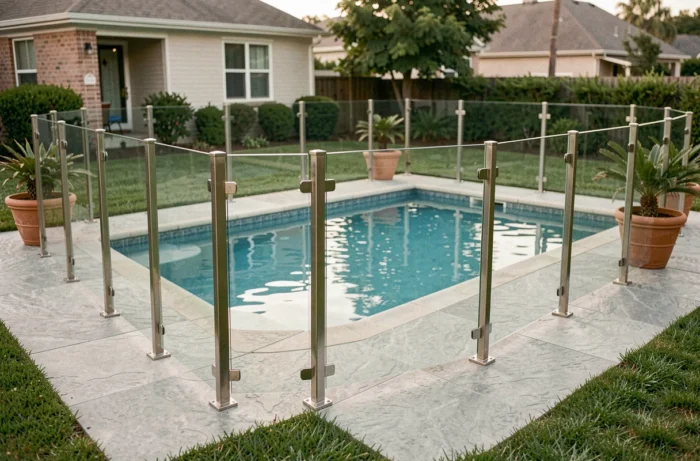
The NF P90-306 standard sets the technical requirements for pool barriers in France, but recent drowning statistics show that compliance on paper is not enough. Summer 2025 recorded 1,418 drownings, including 409 fatalities according to Santé publique France, representing a 14% increase in accidents compared to 2024. Private family pools alone accounted for 53 deaths during this period.
Drownings in private pools: figures that put regulatory protection into perspective
The regulation has mandated a standardized safety device since 2004 for any in-ground or semi-in-ground pool. Barrier, alarm, cover, or shelter: the owner must choose at least one of these four devices. The barrier remains the most common solution.
However, data from Santé publique France reported by the Senate reveal a trend contrary to what was expected. Of the 53 deaths in private family pools during summer 2025, 41 involved adults, not just young children. This finding contradicts the notion that pool regulations are a concern only for families with young children.
Knowing the pool barrier standards to be respected is a prerequisite, but the technical compliance of a barrier does not replace vigilance or the quality of the installation itself.
Technical requirements of the NF P90-306 standard: comparative table of criteria
The NF P90-306 standard precisely defines the characteristics that a pool barrier must meet to prevent a child under 5 years old from passing without the help of an adult. Here are the measurable criteria grouped by category.
| Criterion | NF P90-306 Requirement | Point of vigilance |
|---|---|---|
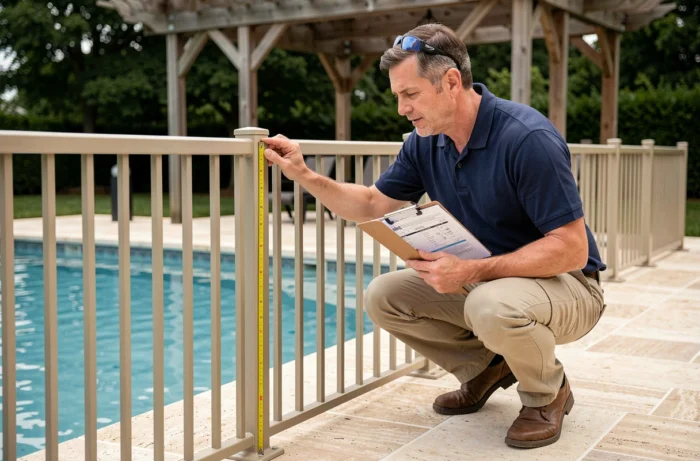
| Minimum height | 110 cm between two support points | Measured from the outside, not from the pool side |
| Spacing of bars/cables | Maximum 102 mm between vertical elements | A child must not be able to pass their head or body |
| Resistance to climbing | Must withstand the actions of a child under 5 years old (climbing, pushing, pulling) | No horizontal support within the first 45 cm |
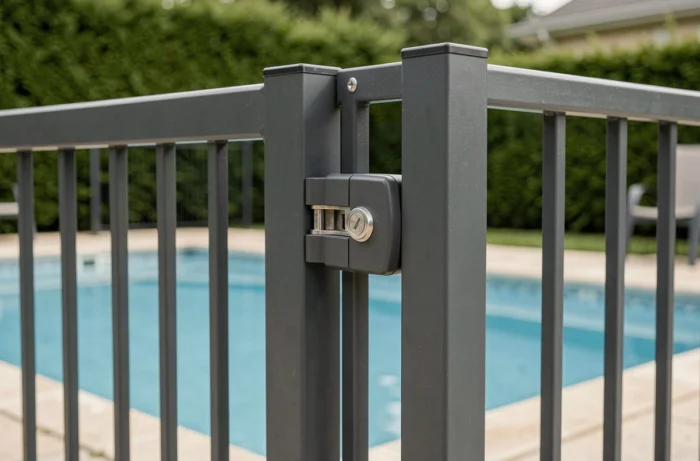
| Gate | Automatic closing and locking, requiring two distinct actions to open | The latch must be out of reach of a child (more than 1 m) |
| Distance to the pool | Minimum 1 m between the barrier and the edge of the pool | Allows for adult intervention from the water side |
The manufacturer or installer must provide a certificate of compliance with the NF P90-306 standard. This document holds their responsibility and is the only admissible proof in case of inspection or dispute.
Pool safety gate: the weak link in installations
The majority of non-compliance issues observed in the field do not concern the height of the barrier or the spacing of the bars. The gate concentrates the most frequent failures.
The standard imposes three cumulative conditions for the gate:
- The closing must be automatic, without manual intervention, via a return system (spring, gravity closure hinge)
- The locking must activate automatically after each closing, not just during the first use
- The opening requires at least two distinct and simultaneous actions, out of reach of a child under 5 years old
A gate that remains ajar because the return mechanism is worn negates all the protection offered by the barrier. A faulty gate is equivalent to the absence of a barrier from a real safety perspective, even if the structure remains in place.
Sanctions and owner responsibility in case of non-compliance
Failure to comply with the obligation to install a standardized safety device exposes the owner to a fine of up to 45,000 euros. This sanction applies to both the total absence of a device and to an installation that does not comply with the standard.
Responsibility does not stop at the initial installation. The owner must ensure the device remains operational over time. A barrier that is compliant upon installation but whose gate no longer locks does not meet the standard’s requirements.
In the event of a drowning, the owner’s criminal liability may be engaged if the safety device was absent, faulty, or non-compliant. The certificate of compliance provided by the manufacturer only protects the owner if the installation was carried out according to the manufacturer’s specifications and maintained in good condition.
Periodic checks to be performed
- Test the automatic closing and locking mechanism of the gate at least once a month during the swimming season
- Check for any deformation of the bars or cables, and measure the spacing if there is any doubt
- Check the stability of the fixing posts, especially after a period of strong winds or impact
- Ensure that no object (garden furniture, toys, flower pots) creates a foothold near the barrier
The increase in drownings recorded in 2024 and 2025 shows that the presence of a barrier does not exempt from active supervision. The 41 deaths of adults in private family pools during summer 2025 remind us that the risk does not only concern children, and that no standardized device can replace human vigilance.