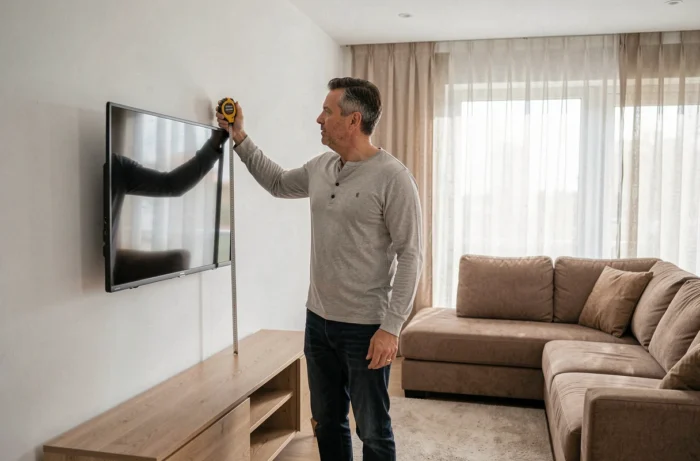
Installing a 75-inch TV on the wall is not just about aiming for a standard height. The diagonal of this screen exceeds 190 cm, which significantly alters the visual comfort zone compared to a 55 or 65-inch television. To determine the ideal height, three variables must be considered: the height of the eyes when seated, the height of the screen itself, and the downward viewing angle.
Dimensions of a 75-inch screen and impact on wall positioning
Competing content offers generic rules (center of the screen at eye level, universal range). None detail why a 75-inch TV requires a lower placement than a smaller model, even though this is the determining factor.
A 75-inch screen measures about 93 cm in height (without a stand). If you center this screen at the same height as a 55-inch, the top edge will be significantly above your line of sight. Your neck compensates by lifting, which causes neck fatigue during long viewing sessions.
The operational rule is simple: the larger the diagonal, the lower the TV must go. The center of the image should remain aligned with your eyes or slightly below, which means the bottom edge of a 75-inch is much closer to the floor than that of a 55-inch.
Understanding at what height to install a 75-inch TV starts with a personalized measurement, not a universal number.
Customized calculation method: eye height and viewing angle
Most guides simply provide a range expressed in centimeters from the floor. This approach ignores the most important variable: the height of your eyes when seated.
Step by step
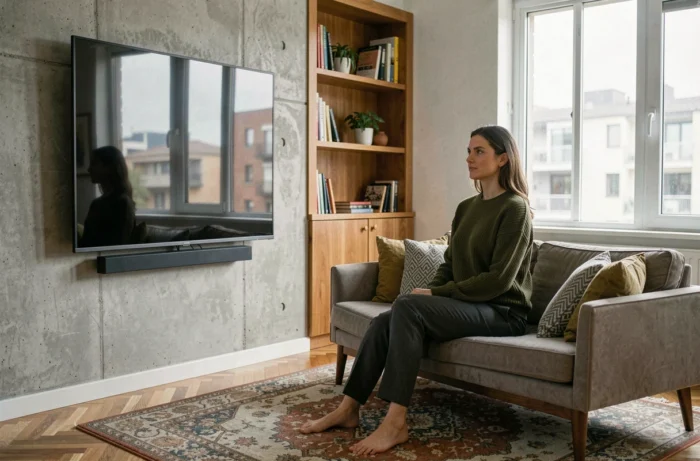
- Sit on your usual sofa or chair, in the posture you actually adopt (not sitting up straight like at the doctor’s). Measure the distance from the floor to your eyes. For most living room seating, this value is around one meter, but a deep and plush sofa can significantly lower it.
- Divide the height of your screen by two. For a 75-inch, half the height is around 46 to 47 cm.
- Subtract this half-height from the floor-eye measurement. The result gives you the height of the bottom edge of the screen relative to the floor.
The appropriate viewing angle is between 10 and 15 degrees downward from the horizontal. In other words, the center of the screen can be slightly below your eye line without any discomfort. This downward shift corresponds to the natural resting position of the gaze.
Why individual measurement changes everything
Two living rooms equipped with the same television may require different mounting heights by several centimeters. A low Scandinavian-style sofa places the eyes closer to the floor than a classic high-seated sofa. Applying a generic value without measuring is like choosing glasses without an eye exam.
Comparison table: height of the bottom edge according to seating type
This table illustrates how installation height varies based on the actual position of the viewer for a 75-inch screen (screen height of about 93 cm).
| Type of seating | Approximate floor-eye height | Center of the screen (target) | Bottom edge of the TV |
|---|---|---|---|
| Low sofa / lounge | About 85 cm | About 80 cm | About 33 cm from the floor |
| Standard sofa | About 100 cm | About 95 cm | About 48 cm from the floor |
| Office chair (multi-purpose use) | About 115 cm | About 110 cm | About 63 cm from the floor |
The differences are clear. Between a lounge sofa and an office chair, the bottom edge of the TV can vary by about thirty centimeters. Copying the installation height of a neighbor whose furniture differs from yours makes no sense.
Fixed or tilting wall mount: what effect on the height of the 75-inch TV
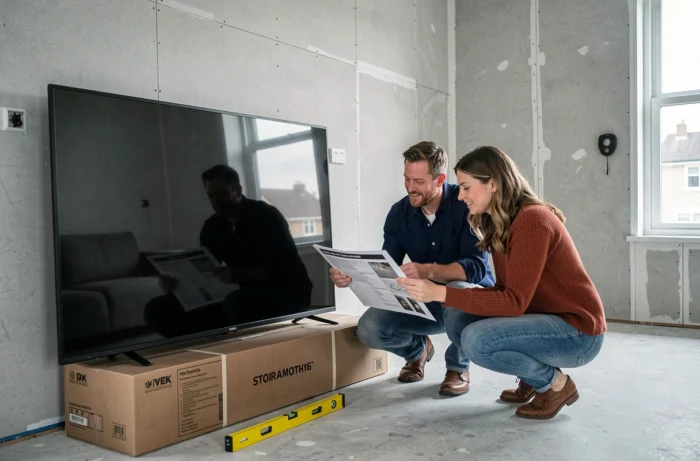
The type of wall mount alters the tolerance margin you have. A fixed mount locks the screen in a single position. If your initial calculation lacks precision, comfort will be affected in the long run.
A tilting mount allows you to angle the screen downward, which permits a slightly higher installation than the theoretical target. This tilt partially compensates for the gap, but within reasonable limits: beyond a few degrees, reflections and loss of brightness on VA or IPS panels become bothersome.
- Fixed mount: requires precise measurement before drilling. No adjustments possible after installation. Prefer it if your wall and furniture will not change.
- Tilting mount: offers correction of a few degrees downward. Useful when the TV is mounted above a low piece of furniture or if multiple viewing positions coexist (sofa and dining table).
- Articulated mount (offset arms): allows you to modify the effective height by moving the screen forward or backward. Relevant for multifunctional rooms, but its weight capacity must be checked, as a 75-inch often exceeds 25 kg.
Viewing distance and consistency with installation height
Height and viewing distance are linked. If you are too close to a 75-inch, your gaze sweeps the screen from top to bottom, amplifying any vertical positioning errors. An appropriate viewing distance reduces the amplitude of this sweep and makes the installation height less critical.
For a screen of this size, layout recommendations suggest a distance sufficient for the entire image to remain in the field of vision without head movement. A distance that is too short forces you to raise or lower your eyes to the edges, negating the benefit of careful centering.
The consistency between the two parameters is often overlooked. Adjusting the height to the exact centimeter while sitting two meters from a 75-inch screen is akin to adjusting the rearview mirror of a car parked askew.
The most important parameter remains the height of your eyes in the actual viewing position. Take a meter, sit down, measure. The rest of the calculation follows mechanically from this, and no standard value will replace this starting data.