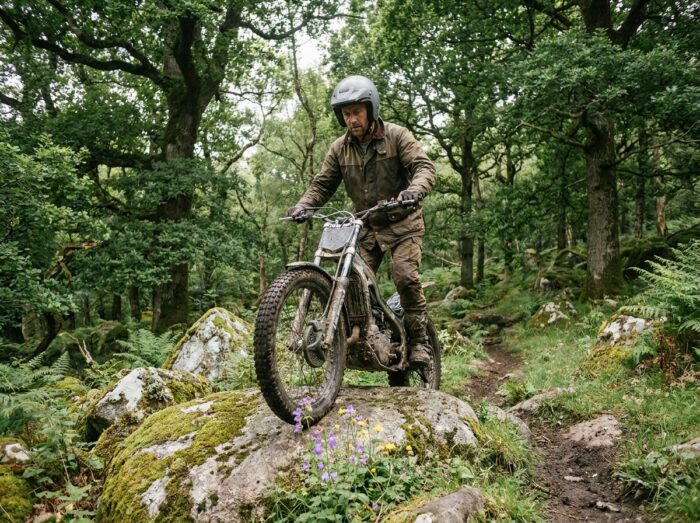
Trial biking is practiced on natural obstacles (rocks, roots, slopes) where the repeated passage of tires and torque jolts directly affect the substrate. Balancing this technical pleasure with respect for nature requires mastering the French regulatory framework, choosing terrains based on specific ecological criteria, and adapting one’s riding style to limit erosion.
Legal framework for off-road motorized vehicles in France
The principle is unambiguous: motorized vehicles cannot travel off public roads. Footpaths, firebreaks, closed forest tracks, and off-road areas are prohibited, even with a road-registered motorcycle. We observe that this rule remains poorly known within the leisure trial community, exposing practitioners to sometimes heavy fines.
In protected areas (Natura 2000, national parks), penalties are significantly harsher. Motorized traffic in these sensitive spaces results in fines well above those for a simple off-road infraction. Before planning an outing, checking the environmental status of the area on the INPN portal or with the local DDT helps avoid this risk.
Trial motorcycles used for sporting purposes may also be exempt from technical inspection if the owner holds an annual FFM license. However, it is still advisable to verify that their motorcycle insurance adequately covers the intended use. This exemption only applies to strictly sporting use on authorized terrain, not for wild riding in the forest.
Choosing trial terrain and its impact on soils
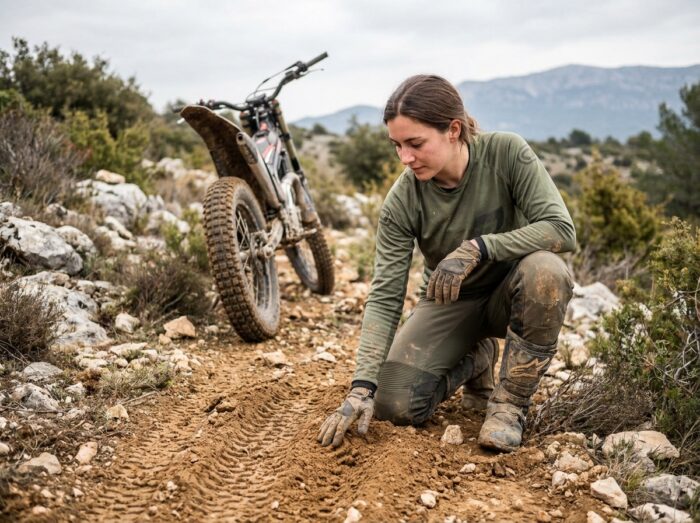
Trial differs from enduro by its reduced speed and more limited ground impact. A trial rider progresses at a crawl, often in first gear, whereas an enduro rider speeds along at high revs. This difference in kinetics radically changes the impact on the substrate, but does not eliminate it.
A wet clay soil experiences measurable compaction after just a few passes. The microorganisms in the topsoil (the first ten centimeters) are the first to be affected. On dry limestone rock, the damage is limited to the superficial wear of the lichen biofilm, which regenerates over several years.
Concrete criteria for evaluating a spot
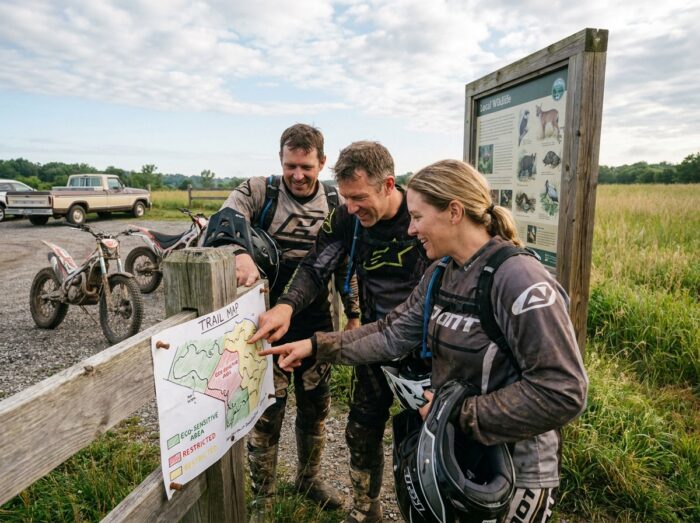
- Check the legal status of the path on the cadastral map or the departmental plan for routes (PDIPR) before any outing, as an open rural path is not a hiking trail
- Favor rocky substrates and disused quarry terrains where pioneer vegetation is nearly absent
- Avoid wetlands, riverbanks, and forest edges during the nesting period (March to July)
- Rotate between several spots to allow each terrain to regenerate between sessions
The most reliable approach remains to ride on private lands with the owner’s consent or on parcels managed by an FFM-affiliated club. These terrains are subject to impact monitoring, even if only basic, and their use is governed by an agreement.
Low ecological impact trial riding techniques
Adapting one’s riding does not mean giving up pleasure. We recommend three adjustments that significantly reduce erosion without altering the practice.
The first concerns clutch management in loose areas. Prolonged slipping while climbing digs a rut in seconds. A precise clutch modulation, combined with a forward weight transfer, maintains traction without tearing up the ground. This technical gesture is acquired through training on hard terrain before being applied in natural settings.
The second pertains to the choice of trajectory. In competition, the course is imposed. In leisure, there is no obligation to pass through a streambed or on a mossy area. Skirting a fragile two-meter obstacle does not diminish the enjoyment of overcoming it but preserves a microhabitat.
The third concerns the engine regime when descending. Engine braking at low revs rather than locking the rear wheel prevents rill erosion. On sloped ground, a locked rear wheel shifts the surface layer and creates a furrow that channels rainwater, accelerating erosion well beyond the initial track.
Electric trial motorcycles and reducing nuisances
Electric trial models (Electric Motion, Mecatecno) eliminate noise and local emissions, two major sources of conflict with residents and managers of natural spaces. The absence of an exhaust system also reduces disturbance to wildlife, particularly nesting raptors sensitive to impulsive sounds.
From a mechanical standpoint, the instantaneous torque of an electric motor can paradoxically worsen soil tearing if the rider does not modulate the throttle. The smoothness of the engine mapping then becomes as relevant a selection criterion as autonomy. Some manufacturers offer “soft” modes that smooth the torque curve in the initial degrees of throttle rotation.
Autonomy remains the main limitation for long outings. In pure trial (technical zones, low speed), consumption remains moderate, and a battery typically lasts for a full session. For mixed trial rides that include connections, thermal engines maintain the advantage of versatility.
The role of clubs and organizing practices in natural environments
An FFM-affiliated club organizing outings or events on natural terrain must obtain a prefectural authorization and, if necessary, conduct an impact assessment if the site is located in a Natura 2000 area. This administrative framework, perceived as restrictive, protects both nature and the club itself in case of disputes.
- Map sensitive areas of the terrain and mark them as off-limits
- Limit the number of simultaneous riders to avoid the proliferation of parallel tracks
- Plan a day for restoring the terrain after each event (filling ruts, replanting if necessary)
- Collaborate with local naturalist associations for a wildlife-flora diagnosis before the season
In Spain, certain regions such as the Valencian Community and Catalonia have recently tightened restrictions for trial and enduro motorcycles in forested areas, with seasonal bans and more detailed zoning than the national framework. This regulatory trend in Europe confirms that the sustainability of the practice directly depends on the riders’ ability to demonstrate responsible use.
Trial remains one of the least impactful motorized disciplines by nature: low speed, low noise (especially in electric), and reduced ground footprint. But this light footprint does not exempt from rigor. Choosing suitable terrain, respecting the legal framework, and adjusting riding technique are the three concrete levers to ensure that today’s spots remain accessible in ten years.