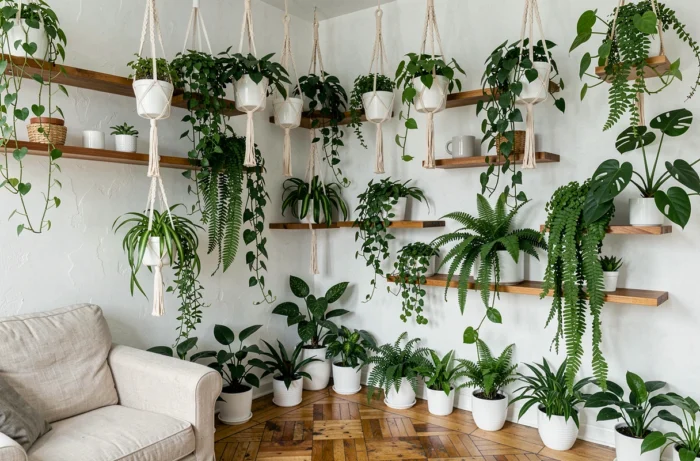
A saturated windowsill, a shelf too low to accommodate an extra pot: we all know that moment when floor space is no longer sufficient. Trailing plants solve the problem by utilizing vertical space, from the top of a bookshelf to a bathroom pot rack. Here are ten specific species, chosen for their cascading habit and ability to thrive in realistic apartment conditions.
1. Scindapsus pictus: the silver velvet that tolerates shade
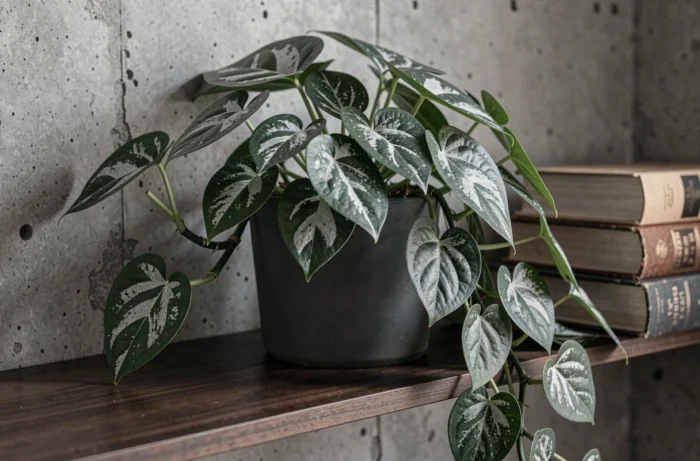
Often confused with pothos, the scindapsus pictus is distinguished by its dark green leaves dotted with silver spots and a velvety texture. Its main advantage: it tolerates dim corners without losing its marbling, where many variegated plants turn green.
In terms of care, allow the substrate to dry out between waterings. Overwatering causes the lowest leaves to yellow quickly. Suspended in a room with indirect light, its stems can easily reach over a meter in a growing season.
If you’re looking for green trailing houseplants that can adapt to a hallway or an office without a south-facing window, the scindapsus pictus is a reliable choice.
2. Rhipsalis: the spine-free cactus that cascades like a curtain
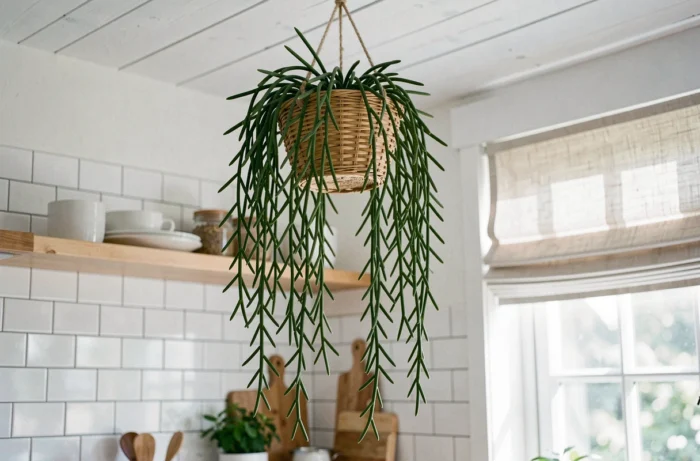
Rhipsalis, sometimes called coral cactus, looks nothing like traditional cacti. Its thin, cylindrical, and branched stems form a dense green curtain. Native to tropical forests, it prefers filtered light and slightly moist substrate, unlike cacti from arid regions.
It can be placed in a macramé hanger or on top of a cabinet. It tolerates heated rooms in winter well, provided it is misted occasionally. Opinions vary on the ideal watering frequency, but a moderate weekly supply works in most interiors.
3. Hoya linearis: almost graphic green threads
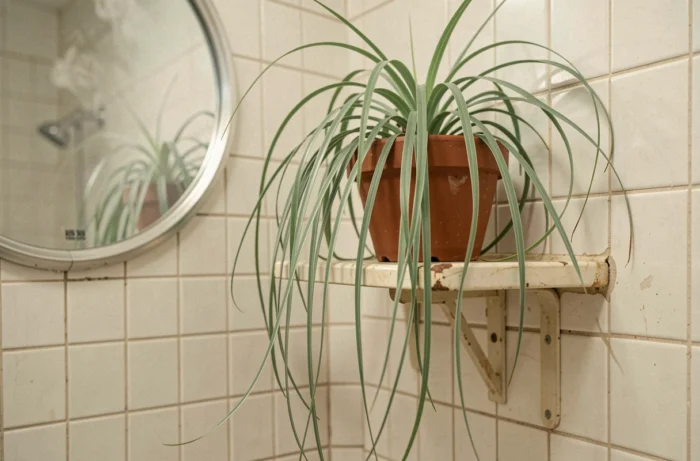
Less known than hoya carnosa, hoya linearis produces long, flexible stems covered with narrow, fuzzy leaves. The visual effect is airier than that of ivy, with an almost textile appearance.
It requires bright but indirect light. An east or west-facing windowsill is perfect for it. Watering should be spaced out: wait for the root ball to dry thoroughly. At the end of summer, it may produce small, fragrant white flowers, a rare bonus among trailing plants.
4. Dischidia nummularia: the discreet money plant
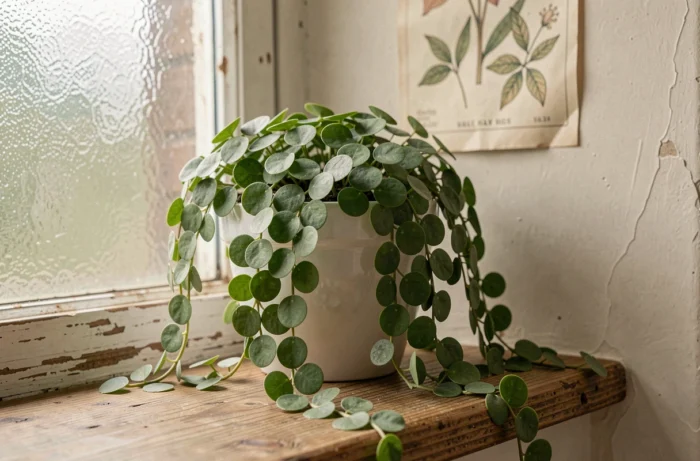
With its tiny, round, flat leaves arranged along slender stems, dischidia nummularia adds a fine texture that contrasts with broad foliage. It is still not commonly found in traditional garden centers, but it can be easily ordered online.
It enjoys a humid atmosphere and thrives particularly well in bathrooms or kitchens. Its substrate should remain airy (bark, sphagnum) to prevent root rot. Growth is slow, which limits care to light watering about every ten days.
5. Peperomia prostrata: the miniature turtle chain
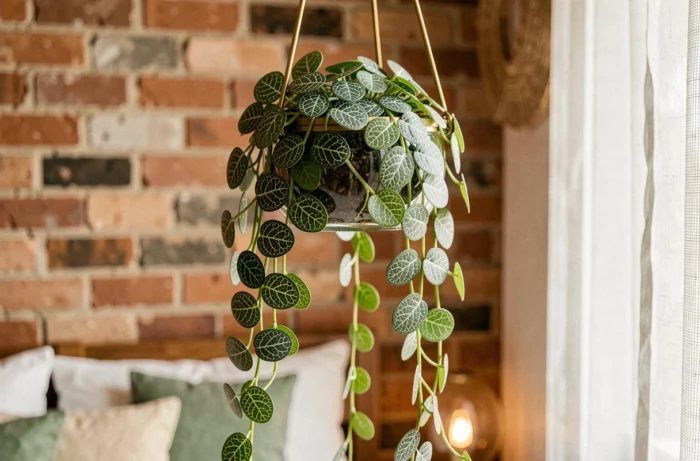
The leaves of peperomia prostrata, with their veins resembling turtle shells, make it a true collector’s plant. Its creeping stems slowly cascade but eventually form a compact curtain.
A common mistake: overwatering. Its succulent leaves store water, and a waterlogged substrate leads to the rapid loss of entire stems. Water only when the substrate feels dry to the touch. A small terracotta pot promotes evaporation and protects the roots.
6. Columnea gloriosa: the trailing plant that blooms indoors
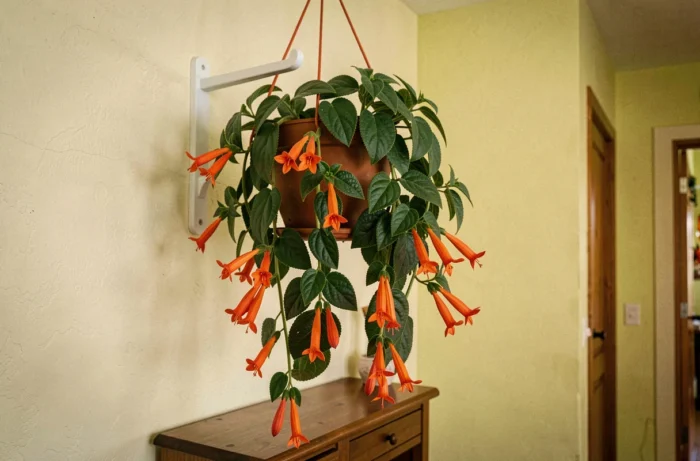
Flowers are rarely sought after in trailing plants, which is precisely what makes columnea interesting. Its tubular red-orange flowers appear in winter, when the rest of the indoor foliage is slowing down.
It requires bright light without direct sunlight and a high humidity level around the plant. A tray of wet clay pebbles under the pot is often sufficient. Columnea remains compact, making it suitable for small hangings in a kitchen or near a living room window.
7. Tradescantia zebrina: rapid growth to fill a wall
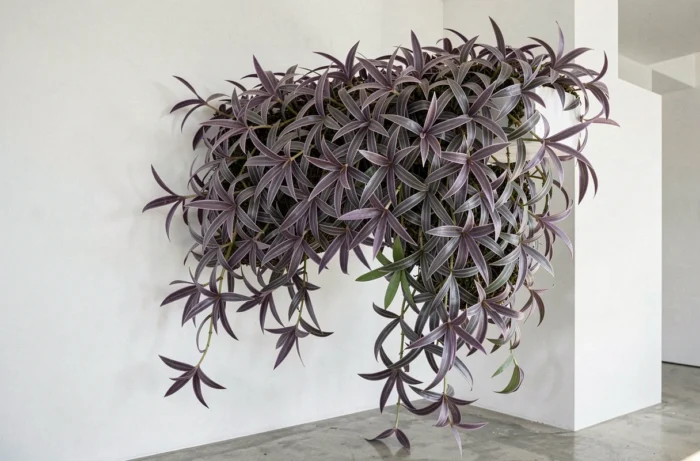
Tradescantia zebrina grows quickly, can be propagated in a glass of water in a few days, and forms dense cascades in a few months. Its purple and silver striped leaves capture light and change hue depending on the angle.
To maintain vibrant colors, place it in a well-lit room. In the shade, the foliage tends toward solid green. Regularly pinching the tips helps avoid bare stems at the base, a common flaw with this species.
8. Asparagus setaceus: the faux fern with airy foliage
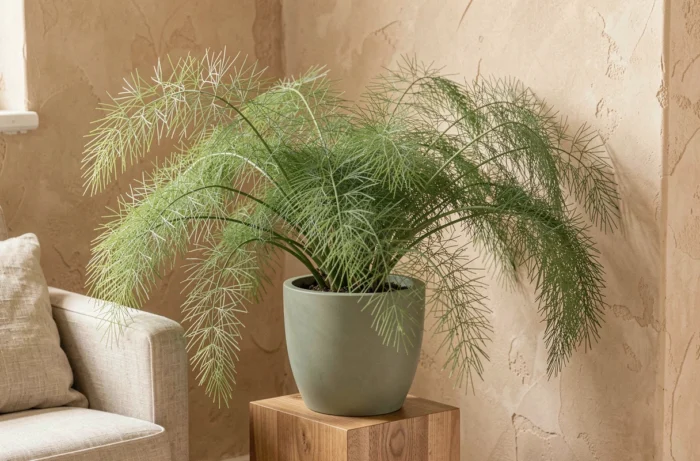
Asparagus setaceus, often sold as asparagus fern, is not a fern. Its feathery, horizontal fronds create a light, almost airy volume that softens a shelf or tabletop.
It tolerates medium light and requires regular watering without excess. In case of prolonged drought, its needles turn yellow and fall off. A good habit: check the substrate moisture twice a week during summer.
9. Senecio herreianus: cascading oblong pearls
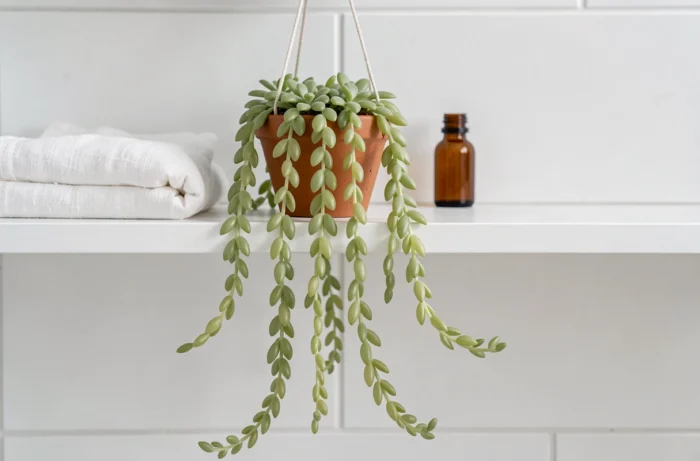
A cousin of the famous string of pearls (senecio rowleyanus), senecio herreianus is recognized by its striped oval leaves. It proves to be more tolerant of watering mistakes than its spherical cousin, making it a better choice for beginners.
It should be planted in a draining cactus substrate and watered sparingly. A bright location without direct sunlight ensures steady growth. Its stems remain shorter than those of rowleyanus, but their density more than compensates.
10. Ficus pumila: the tropical ivy that covers an entire wall
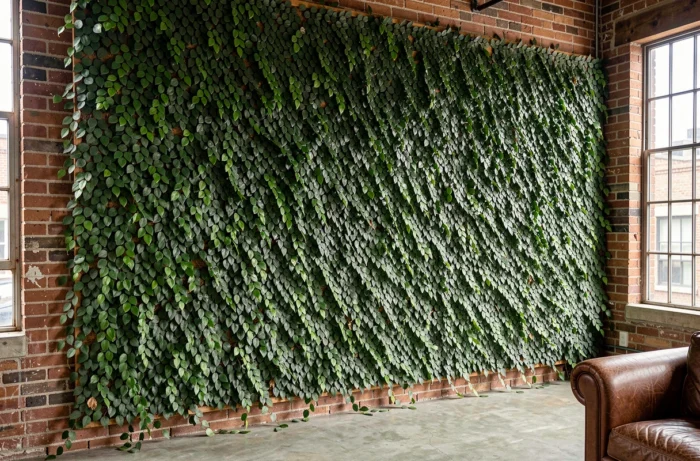
Ficus pumila, or creeping fig, is a tropical alternative to classic ivy. Its small heart-shaped leaves cling to surfaces with fine aerial roots, but in a raised pot, it cascades with the same generosity.
It enjoys consistent humidity and moderate light. In a hanging pot, be careful not to let the substrate dry out completely, or the leaves will curl. In terms of decor, it fits well in both a living room and a bathroom, where the ambient humidity benefits it directly.
- For a quick vertical jungle effect, combine tradescantia zebrina and scindapsus pictus at different heights.
- In dark rooms (hallway, north-facing office), prefer scindapsus pictus or rhipsalis over hoya linearis.
- In humid rooms (kitchen, bathroom), dischidia nummularia and ficus pumila acclimate better than succulent species.
Each trailing plant imposes its conditions for light and watering. Before investing in a hanging or macramé, check the room’s orientation and the proximity of a water source for regular maintenance. A good match between the species and its location avoids most failures.