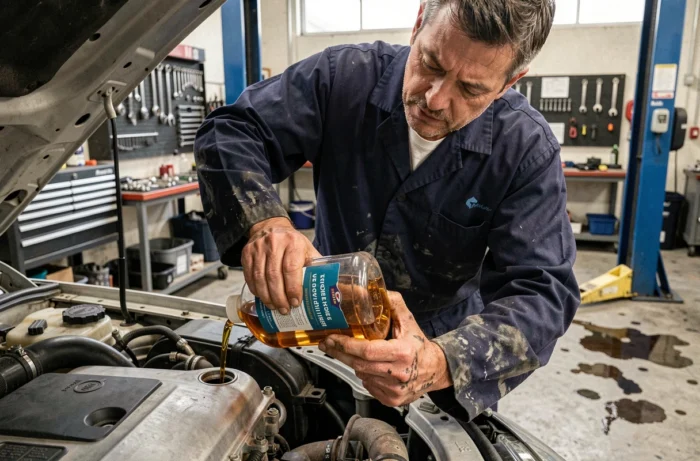
A gearbox accumulates metallic residues, friction deposits, and oxidation traces over the kilometers. Draining is not always enough to eliminate these contaminants, especially when the used oil has stagnated for a long time. Using a specific flushing product can, under certain conditions, restore the internal cleanliness of the casing and improve the transmission’s performance.
When flushing a gearbox can backfire
Maintenance guides often present flushing as a beneficial operation without nuance. Feedback from specialized workshops tells a different story, documented for several years on high-mileage automatic transmissions.
The mechanism is counterintuitive: in a heavily worn gearbox, part of the friction capacity of the internal clutches comes from wear micro-particles suspended in the fluid. These particles, far from being solely harmful, compensate for the wear of the friction surfaces that have become too smooth. A highly detergent cleaner removes them all at once.
The result, sometimes observed within a few hundred kilometers after the operation: clutch slipping, hesitant gear shifts, followed by rapid degradation of the transmission. Garages document these cases and recommend, for gearboxes with an unknown maintenance history, to proceed with partial drain series without aggressive solvent rather than a single flush with a highly detergent product.
Before using a gearbox flushing cleaner, it is essential to assess the actual condition of the transmission. A regularly maintained gearbox with oil changes spaced according to the manufacturer’s recommendations can handle a flush well. A neglected gearbox over tens of thousands of kilometers presents a real risk.
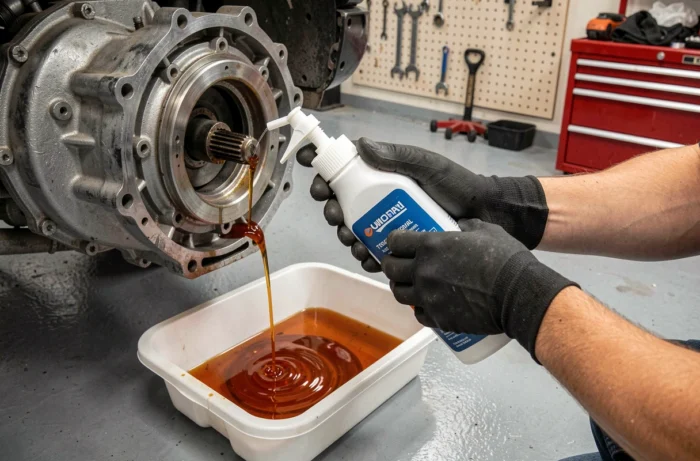
Flushing product for gearbox: choose according to the type of transmission
Not all cleaners are suitable for all gearboxes. The fundamental distinction separates manual transmissions from automatics, as the requirements for friction and chemical compatibility differ radically.
Manual gearbox
Manual gearboxes use mineral or synthetic-based oils, often classified as GL-4 or GL-5. Flushing generally involves filling the casing with a cheap oil or a dedicated flushing fluid, briefly running the mechanism, then draining before filling with the final oil. The technical document from Klüber Lubrication describes three levels of intervention based on the level of contamination:
- Clean gearbox: drain the hot oil, inspect the gears, replace the filters, fill with new oil.
- Contaminated gearbox: fill with flushing oil, run idle for 30 to 60 minutes, drain the flushing oil, then inspect and fill finally.
- Heavily contaminated gearbox: partial drain, fill with a specific solvent (type Varnasolv), use for 24 to 48 hours before complete drain and new fill.
Automatic gearbox
Automatic transmissions are more sensitive. The ATF fluid serves hydraulic, lubricating, and friction functions simultaneously. An overly aggressive cleaner can alter the friction properties of the internal clutch discs. The flushing product must be compatible with the manufacturer’s ATF specifications, or it may cause shifting malfunctions.
Field feedback diverges on this point: some professionals use cleaning additives added directly to the used ATF before draining, while others prefer a gravity flush with new ATF, without any chemical additives.
Step-by-step flushing protocol for reliable results
The method is as important as the choice of product. A poorly conducted flush leaves residues of cleaner in the casing, which degrades the new oil from the first kilometers.
Draining hot remains the first rule. Hot oil is more fluid and carries more suspended particles. Driving for about ten minutes before draining significantly improves the extraction rate of contaminants.
After the initial drain, the flushing cleaner is poured into the casing according to the dosage indicated by the product manufacturer. The gearbox then runs idle or under light load for the prescribed duration, which varies from a few minutes to several hours depending on the level of contamination and the type of cleaner.
The draining of the flushing fluid must be complete. Any trace of residual solvent alters the properties of the new oil, particularly its anti-wear additives and friction modifiers. For gearboxes equipped with a filter or strainer, replacing this element at this stage is strongly recommended.
The final filling is done with the oil recommended by the manufacturer, respecting the exact level. An excess of oil in an automatic gearbox causes foaming, while an insufficient level accelerates wear due to lack of lubrication.
Common mistakes when cleaning a gearbox
Several common practices compromise the effectiveness of the flush or damage the transmission.
- Using diesel as a flushing liquid: this old method, still mentioned on forums, damages seals and has no lubricating properties. Modern O-rings and sealing rings do not tolerate light hydrocarbons.
- Flushing a high-mileage gearbox without prior diagnosis: as mentioned above, flushing can reveal masked wear and hasten failure.
- Mixing products from different brands: the additives in each formulation can interact unpredictably, creating deposits or neutralizing anti-friction properties.
- Neglecting contact time: a flush that is too brief does not dissolve deposits, while a flush that is too long with an aggressive solvent attacks metal surfaces or friction linings.
Adhering to the recommendations of the cleaner manufacturer, combined with those of the car manufacturer, remains the only reliable approach. Regular maintenance with oil changes at the correct intervals reduces the need for flushing. The best strategy for cleaning a gearbox is to never let contamination set in.