
The combination of design and technology in our everyday objects creates a paradoxical effect. The more sophisticated the systems become, the more they seek to be forgotten. Interfaces disappear behind usage, sensors blend into furniture, and algorithms anticipate our needs even before we articulate them.
This trend towards technical invisibility deserves to be examined from a rarely addressed angle: that of the real autonomy left to the user in the face of these experiences designed to eliminate all friction.
Invisible technology and everyday design: what fluidity conceals
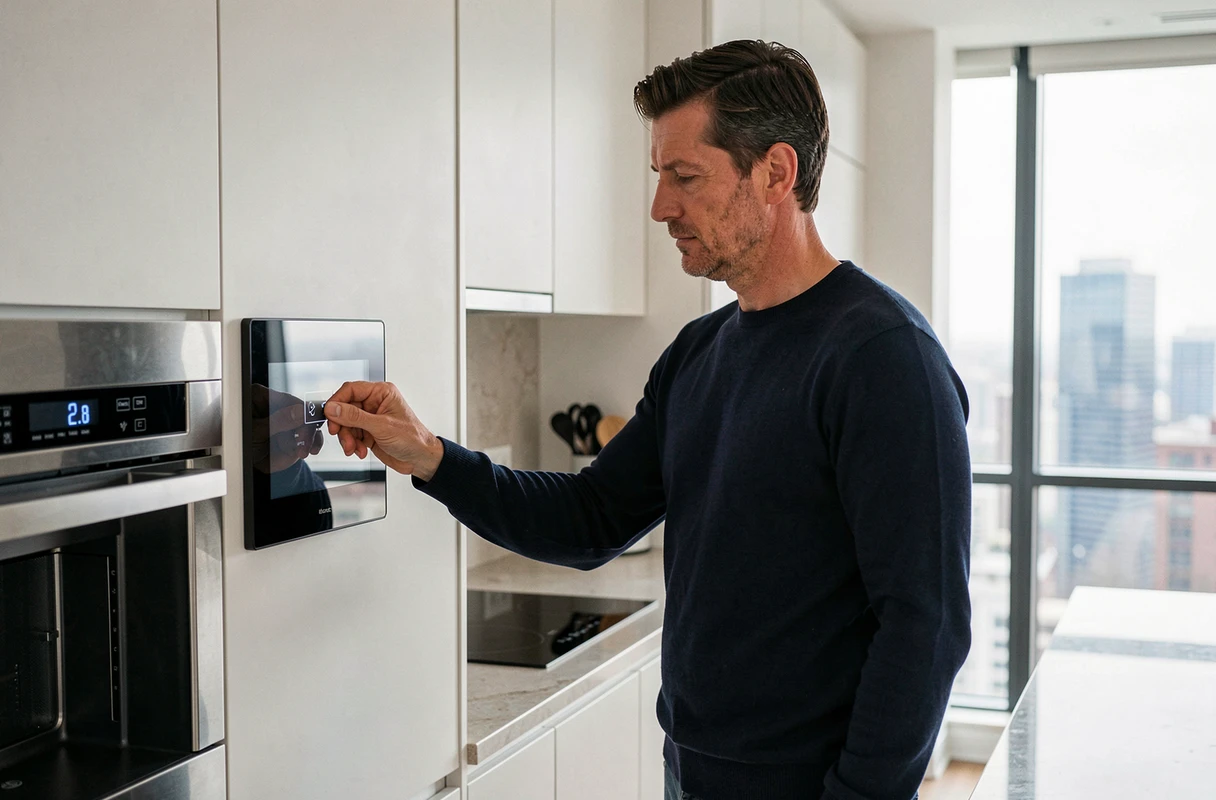
Recent innovations in smart homes, wearables, and spatial interfaces share a common goal: to make technical complexity disappear behind a seamless usage. A thermostat that learns your schedule, a watch that adjusts its alerts to your heart rate, lighting that modulates its temperature according to the time: in each case, design absorbs technology so that the user no longer has to intervene.
This model relies on an increasing integration of sensors, real-time data processing, and automated feedback loops. The user experience gains in comfort and apparent simplicity. The initiative Mix Design and Tech documents this convergence between aesthetic creation and engineering, where the two disciplines stop functioning in silos to produce coherent objects and services.
The question that arises is not one of technical performance, but of decision transfer. Each friction removed corresponds to a choice delegated to an algorithm or a sensor. The gain in comfort has a structural cost in terms of visibility over the decisions made on our behalf.
Frictionless experience and user autonomy: a balance of trade-offs
To concretely measure what the user gains and what they relinquish, it is necessary to distinguish between areas where technological delegation is benign and those where it alters the capacity for choice.
| Domain | Gain from removed friction | Potential loss for the user |
|---|---|---|
| Smart home (lighting, heating) | Adapted thermal and lighting comfort without intervention | Loss of awareness of energy consumption |
| Health wearables | Preventive alerts, continuous physiological monitoring | Dependency on the device to assess one’s own state |
| Recommendation interfaces (content, purchases) | Accelerated discovery, time savings | Gradual reduction of visible choice spectrum |
| Voice assistants and AI agents | Quick execution of recurring tasks | Opacity of selection and prioritization criteria |
The level of risk varies depending on the reversibility of the delegation. Adjusting a thermostat manually remains possible in a few seconds. However, when a recommendation algorithm filters visible options without indicating what it excludes, the user loses the very ability to know that a choice existed.
Algorithmic biases in experience design
Intelligent systems that recommend, prioritize, or automate daily choices pose a problem of bias. An assistant that systematically suggests the same categories of products or content creates a reinforcement loop. Interface design, if solely aimed at maximizing fluidity, becomes the vector for this reduction of possibilities.
A design that conceals its own decisions is not a neutral design. The aesthetics of simplicity can serve as a cover for a choice architecture that is directed. The distinction between a system that simplifies and a system that decides on behalf of the user often hinges on one element: transparency regarding filtering criteria.
Health, well-being, and connected objects: beyond comfort
The integration of physiological monitoring into everyday objects goes beyond mere comfort. Recent wearables incorporate functions for preventive alerts and environmental adaptation to the user’s biological rhythm. This convergence between design, technology, and health constitutes a use case where the removal of friction can have direct consequences on personal safety.
- Physiological sensors integrated into watches and bracelets continuously measure parameters that the user could not assess alone, such as heart rate variability or deep sleep quality.
- The automatic adaptation of the home environment (lighting, temperature, ambient noise) to the biological rhythm detected by these sensors creates a closed loop where the body and habitat communicate without conscious intervention.
- Preventive alerts, when well-calibrated, can signal an anomaly before the user feels symptoms, representing a real gain in prevention.
Conversely, dependence on these devices to assess one’s own physical state poses a documented problem. The user may lose confidence in their own sensations in favor of a digital indicator. The design of these objects thus has a direct responsibility: to make information accessible without replacing personal judgment.

Designing transparent experiences without sacrificing simplicity
The tension between fluidity and autonomy is not a dead end. It calls for a design that integrates transparency as a functional component, not as a cosmetic addition.
Specifically, this means that every automation should offer readable access to the criteria that triggered it. A connected thermostat can display, in one line, the reason for the temperature adjustment. A recommendation system can indicate the number of options excluded and the main reason for filtering. These micro-information do not slow down the experience if they are integrated into the visual design of the interface.
Design approaches to preserve choice
Design professionals working with AI face a new constraint: to accelerate creation while avoiding that automation standardizes results. This tension is also present on the user side. Good experience design makes technology readable, not just fluid.
Among the documented approaches, three stand out for their effectiveness:
- “Visibility design” involves making perceptible the moments when a system makes a decision, through a discreet but identifiable visual signal.
- The option for manual regain of control, accessible with a gesture, allows the user to temporarily disable automation without leaving the interface.
- Comparative presentation, which shows the recommended choice alongside at least one alternative, reduces the effect of algorithmic tunneling.
These mechanisms do not add friction. They add readability to the decision-making process, which is a different function. Design and technology, when they converge on this goal, produce experiences that are both simple and respectful of user autonomy.
The next step in this alliance between design and technological innovation will likely play out in this arena. The objects and systems that will earn users’ lasting trust will not be the most invisible, but those that can show, at the right moment, what they are doing and why.