The sports equipment market in France covers thousands of products, from running shoes and technical clothing to protective gear. With so much choice, the criteria for making a decision go beyond price or brand. Repairability, fit, safety standards and durability now all play a part in purchasing decisions—sometimes as much as outright performance.
Repairability and reuse: two overlooked buying criteria
Before comparing the technical features of a bike, a pair of running shoes or ski equipment, it’s worth asking one question: will this item be repairable when it wears out? Sports and leisure goods are eligible for the repair bonus, a scheme that offers a discount when the work is carried out by an approved repairer.
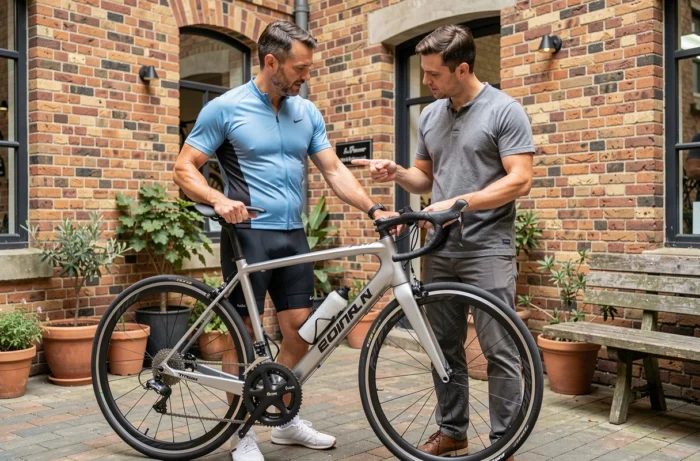
In practical terms, this means that the availability of spare parts and access to a nearby repairer are now important selection criteria in their own right. A bike with an easily replaceable derailleur will cost less over time than a technically superior model that can’t be serviced locally.
ADEME also reports that reuse and second-hand markets are growing in France. Its public platform, “Que faire de mes objets et déchets” (“What should I do with my items and waste?”), helps users find nearby reuse and repair options.
For expensive equipment or items used only occasionally (skis, water sports gear), comparing new, second-hand and rental options is part of the decision. Browsing Sport Essex’s equipment gives you an idea of the available ranges before deciding between a new purchase and the alternatives.
Sports shoes: what your shoe size doesn’t tell you
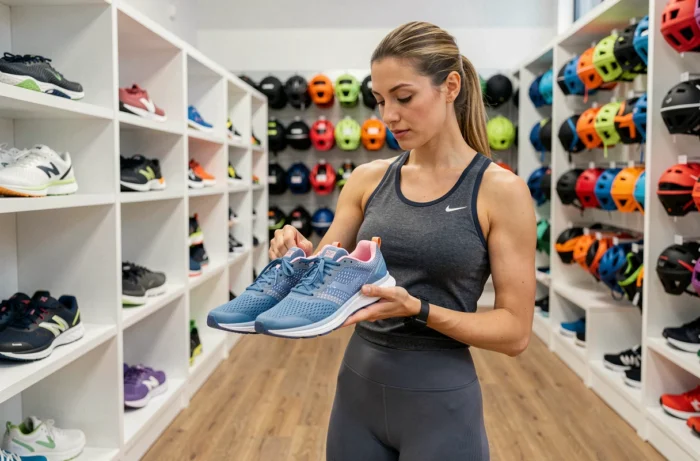
Most guides recommend “choosing the right size.” The problem is that shoe size alone doesn’t guarantee a good fit. Two size 42 running shoes can differ dramatically in arch width, drop (the heel-to-toe height difference) and cushioning.
For running, drop directly affects your stride. A higher drop (around ten millimetres) encourages a heel strike, while a lower drop promotes a midfoot strike. The right choice depends on the runner’s biomechanics, not on a marketing trend.
- Fit width: some manufacturers offer “wide” versions for broader feet, a detail rarely mentioned in general sports stores.
- Terrain: a trail shoe with lugs is nothing like a smooth road-running shoe, even if both are labelled “running.”
- Frequency of use: above a certain weekly mileage, alternating between two pairs reduces wear and the risk of injury.
How comfortable a shoe feels during a five-minute try-on in a shop doesn’t predict how it will perform after an hour of exercise. If possible, testing it on a treadmill at a specialist store gives you a more reliable indication.
Technical clothing: fibres, PFAS and upcoming regulations
Sportswear is about more than comfort. Fibre composition determines breathability, temperature regulation and the textile’s lifespan. A quick-drying synthetic fabric works well for running, while naturally antibacterial merino wool remains a good choice for hiking or cross-country skiing.
A less visible issue concerns PFAS (per- and polyfluoroalkyl substances), which are used in the water-repellent treatments applied to many outdoor jackets and trousers. France plans to ban PFAS in clothing textiles from 2026. This will directly affect waterproof sportswear.
For shoppers, this raises a practical question: should you invest now in a PFAS-treated jacket, given that several manufacturers already offer fluorine-free alternatives? PFAS-free water-repellent treatments lose effectiveness more quickly after repeated washing, but have a lower health and environmental impact. There is not yet enough publicly available data to make a definitive comparison of their durability, as independent testing in this area remains limited.
Protective equipment: standards and replacement frequency
Bike helmets, football shin guards and ski knee pads are all subject to certification standards. A bike helmet sold in France must comply with the current European standard, which guarantees a minimum level of impact absorption.
What these standards don’t always specify is the equipment’s actual lifespan. A bike helmet that has sustained an impact—even without any visible cracks—loses some of its ability to absorb shocks. EPS foam (expanded polystyrene) compresses irreversibly. Replacing a helmet after any significant impact is a non-negotiable safety rule.
- Helmets: check the manufacturing date. After five years of regular use, materials deteriorate even if the helmet hasn’t been hit.
- Joint protection: stitching and padding wear down over time, reducing the level of protection.
- Ski equipment (back protectors, protective gear): standards evolve, and a model that complied ten years ago may no longer offer the same level of protection as a newer one.
Choosing sports equipment to match how often you train
Occasional exercisers and committed athletes have different needs, but the distinction is rarely clear-cut. The most reliable measure is weekly frequency combined with intensity.
For one or two moderate-intensity sessions a week, entry- or mid-range equipment does the job without unnecessary expense. For more than three sessions a week, or activities involving high mechanical stress (trail running, team sports, cycling), investing in mid- to high-range equipment is worthwhile for its durability and comfort.
A common mistake is buying high-end equipment for a beginner, when the body and technique are still changing rapidly during the first few months. Choosing equipment suited to your current level, then replacing or upgrading it as you progress, is the most sensible strategy both financially and athletically.
Choosing sports equipment is best approached as a balance between performance, durability and repairability. Regulatory changes around PFAS, the growth of reuse and the availability of the repair bonus are gradually changing which criteria matter most. Taking the time to check spare-part availability, textile composition and the actual condition of protective gear can help you avoid unnecessary spending and poorly assessed risks.