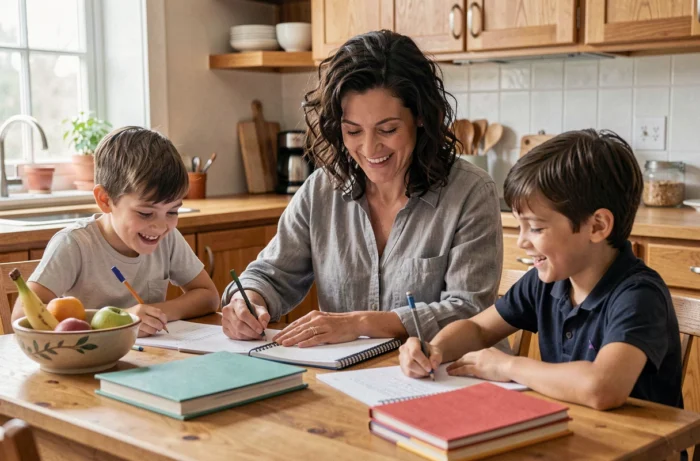
On a rainy Wednesday afternoon, three children running in circles and a parent juggling between snack time and a work call: we all know this scenario. Instead of listing miracle recipes, let’s focus on three concrete levers that truly change the daily lives of families in terms of education, leisure, and practical living.
Home Education: The Legal Framework Parents Need to Know
When considering withdrawing a child from school to educate them at home, the first surprise is not pedagogical. It is administrative. Since the start of the 2022 school year, home education operates under a prior authorization regime, rather than just a simple declaration.
Four valid reasons are accepted: the child’s health or disability, intensive sports or artistic practice, geographical distance from an educational institution, and a situation specific to the child justifying the educational project. Outside of these cases, the request will be denied.
The timeline is tight. Applications must be submitted between March 1 and May 31 preceding the targeted school year. Missing this window means postponing the project by a year. Useful resources for navigating these processes can be found on La Family, particularly for connecting with feedback from other parents.
Regarding penalties, educating without authorization can result in a fine of 1,500 euros, doubled in case of repeat offenses. In the most serious situations, the law provides for fines of up to 30,000 euros and two years of imprisonment. This tightening has significantly reduced the number of families practicing home education.
For parents who obtain authorization, educational checks are organized by the academy. It is better to document the child’s progress from the first month, with a tracking notebook or a digital portfolio, rather than scrambling to compile a file in a rush before the inspection.

Screen-Free Leisure: Family Activities That Last
We often talk about alternatives to screens by mentioning painting or salt dough. The problem is not the idea: it’s the consistency. An activity that requires an hour of preparation and ten minutes of cleanup will not survive the second week.
Focus on Reproducible Formats
Activities that work over time share a common point: they require almost no preparation. A board game kept permanently on an accessible shelf, a shared drawing notebook where each family member adds a sketch each day, or a fixed Sunday morning walk in the same park with a naturalistic goal (counting bird species, photographing mushrooms according to the season).
The ritual matters more than novelty. Children take ownership of an activity when it becomes predictable, not when it surprises them every week.
Cooking Together Without Turning the Kitchen into a Battlefield
Involving children in meal preparation works, provided expectations are lowered. We are not aiming for a gourmet dish. We choose a recipe with a maximum of three steps, assign a specific task to each person (washing vegetables, measuring flour, mixing), and accept that the work surface will be messy.
- Assembling recipes (wraps, open-faced sandwiches, composed salads) avoid cooking and are suitable for younger children
- A visible timer helps children understand time without asking “when are we eating” every two minutes
- Displaying the recipe in pictures (cut out from a magazine or drawn) makes the activity accessible from age four or five
The goal is not to train a future chef. It is to create a moment of concrete cooperation where each child has an identifiable role.
Parents’ Practical Life: Managing Daily Life Without Aiming for Perfection
The classic trap is wanting to optimize every minute. Color-coded planning on the fridge, Sunday meal prep, rotating toys according to a Scandinavian method found online. On paper, it’s appealing. In practice, an overly rigid system breaks down at the first unexpected event (sick child, postponed meeting, broken washing machine).
Parent-School Relations: Anticipate Rather Than Suffer
The school journey generates an underestimated mental load. Relations with the school are not limited to evening homework. Meetings with teachers, administrative forms, school outings, requests for PAP or PAI for children with specific needs: each task adds to the others.
A useful reflex: create a digital folder for each child (on the phone or in a family cloud) with report cards, meeting notes, and school correspondence. When looking for a document for an orientation file or a school transfer, everything is in one place.
Difficult Behaviors: When Kindness Is Not Enough
Gentle parenting has brought valuable tools for managing emotions. Feedback varies on this point, but certain situations (systematic opposition, prolonged crises, relational difficulties at school) go beyond the scope of classic parenting tips.
- A behavior that persists despite a stable and coherent framework deserves an external perspective (doctor, school psychologist, CMP)
- Asking for help is not an admission of failure: it is recognizing that the child’s needs exceed the family sphere
- Neuropsychological assessments can identify specific profiles (attention disorders, high potential, dys disorders) that require tailored responses
Waiting for “it to pass with age” sometimes delays support that could have been implemented much earlier. The earlier the identification, the more effective the adaptations are for the school journey and relationships with adults as well as with other children.
Family life cannot be managed with a manual. What works is often a mix of minimal structure, simple rituals, and the ability to ask for help when the situation demands it. There’s no need to reinvent everything each month: consolidating two or three solid family habits yields more results than a dozen abandoned resolutions.