
Shilajit is not a stimulant. This distinction shapes everything else: its mechanism of action, the responder profile, the supplementation window, and realistic performance expectations. We often observe confusion between progressive adaptogenic effects and acute stimulation, leading to premature dropouts and unjustified negative reviews of an active ingredient whose potential is real but targeted.
Fulvic acid and mitochondrial transport: the mechanism that product sheets ignore
The active fraction of shilajit relies on its content of fulvic acid and dibenzo-alpha-pyrones. These compounds directly participate in the electron transport chain at the mitochondrial level, facilitating ATP production without adrenergic stimulation.
Specifically, shilajit does not mobilize catecholamines like caffeine or synephrine. It gradually improves cellular energy efficiency. This is why no user feels a “peak” after the first dose.
Fulvic acid also acts as a transporter of micronutrients across cell membranes. This property explains why shilajit is sometimes associated with mineral complexes in supplementation protocols: it enhances their bioavailability. If you’re looking to delve deeper into this topic, Medic Com’s health tips detail this mechanism applied to performance.
We recommend not evaluating the effectiveness of shilajit before a minimum of four weeks of regular intake. Clinical trials using the standardized PrimaVie extract measured effects on muscle strength retention after eight weeks of supplementation, not after three days.

Shilajit and testosterone: a real but limited effect for a specific profile
The most widespread marketing argument associates shilajit with a rise in testosterone presented as universal. The clinical reality is more restrictive.
Available human data show a significant effect on total and free testosterone in middle-aged men with low-normal levels, after standardized dose supplementation for about three months. This hormonal profile typically corresponds to men over forty, sedentary or moderately active, whose androgen production physiologically declines.
In a young eugonadic athlete (normal hormonal production), no solid data demonstrate a comparable increase. Extrapolating results observed in deficient subjects to athletes in full hormonal health is a generalization bias. This point is systematically absent from mainstream content.
Implications for sports supplementation
Shilajit does not replace a hormonal optimization protocol based on sleep, stress management, and nutrition. It can be a relevant supplement for practitioners over forty whose hormonal assessment reveals a relative deficit.
For a younger athlete, the expected benefit lies more in the mitochondrial aspect and recovery than in the hormonal axis.
Physical performance under shilajit: adaptation to effort, not acute stimulation
Trials conducted with standardized extracts in physically active men have highlighted two reproducible outcomes:
- Better retention of muscle strength after a fatiguing exercise protocol, measured by the difference in maximum strength between pre and post-exercise
- Reduction of muscle fatigue markers after several weeks of supplementation, suggesting better tolerance to training load accumulation
- Absence of acute ergogenic effect, confirming that shilajit acts as an amplifier of adaptation rather than as an immediate performance stimulant
This distinction has a direct practical consequence: shilajit is better positioned in the phase of general physical preparation or during progressive loading than in pre-competition. Expecting it to act as a “pre-workout booster” leads to guaranteed disappointment.
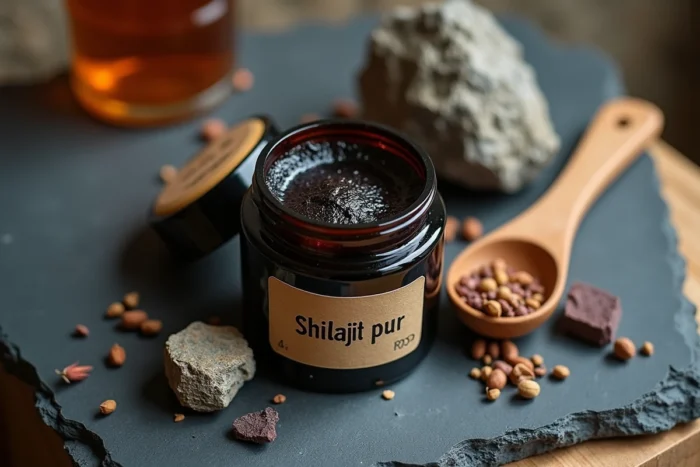
Quality criteria for shilajit: what separates an active extract from an inert product
The variability of quality in the shilajit market is considerable. A poorly purified product may contain heavy metals, mycotoxins, or simply an insufficient concentration of fulvic acid to produce a measurable effect.
We recommend checking several points before any purchase:
- The presence of a fulvic acid standardization, ideally expressed as a percentage on the label or technical sheet
- A certificate of analysis from a third-party laboratory confirming the absence of heavy metal contamination (lead, arsenic, mercury)
- The galenic form: purified resin remains the most concentrated traditional form, while capsules and powders are often diluted with excipients
- The geographical origin and traceability of the harvest, with Himalayan altitude shilajits having been the subject of more studies than those from other regions
Resin or capsules: a choice that impacts actual dosage
Raw resin offers a higher concentration of active ingredients per dose. In capsules, the displayed dosage often includes the weight of the excipient, which reduces the actual amount of fulvic acid ingested. Compare products based on the dosage of fulvic acid per dose, not on the total weight of the capsule.
Cognition and shilajit: a under-documented but coherent axis
The cognitive aspect of shilajit has fewer publications than the physical aspect. Proposed mechanisms revolve around neuroprotection by fulvic acid, which has documented antioxidant properties in vitro, and mitochondrial support in energy-demanding neurons.
In practice, users report improved mental clarity and concentration on prolonged tasks after several weeks of intake. These feedbacks are consistent with the mitochondrial mechanism, but we still lack large-scale controlled trials to precisely quantify this effect in healthy subjects.
Shilajit affects mental performance through the same lever as physical performance: the optimization of cellular energy production. This mechanistic coherence reinforces the plausibility of the effect, even in the absence of definitive evidence on the isolated cognitive aspect.
Shilajit deserves its place in a reasoned supplementation strategy, provided the right profile is targeted (recovery, adaptation to effort, hormonal support in deficient subjects) and a properly standardized extract is chosen. Expecting more would be like asking it to be what it is not.