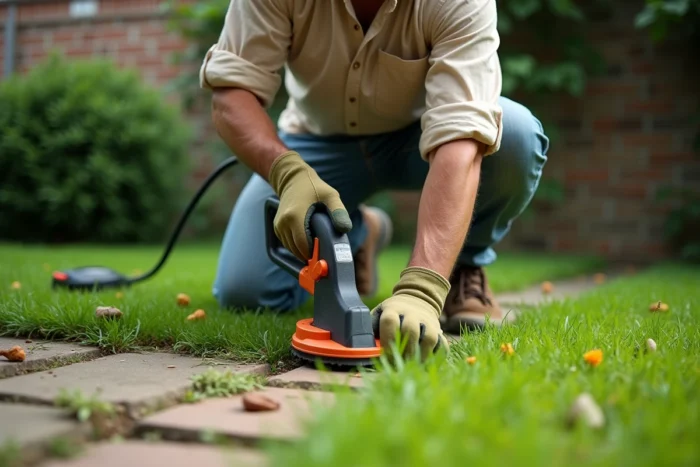
A string trimmer is not just for shortening grass along a wall. For those who own a robotic mower, winding paths, or delicate flower beds, the challenge is to achieve a clean and even finish without damaging nearby plants. The cutting precision, handle maneuverability, and type of line or blade are more influential in the choice than raw power.
String trimmer and robotic mower: caring for the peripheral strip that the machine does not cover
Robotic mowers always leave a strip of uncut grass around the perimeter of the mowing area. This margin, a few centimeters wide, runs along walls, fences, and flower bed edges. This is precisely where a string trimmer comes into play.
The classic pitfall is choosing a model that is too wide or too powerful for this task. A device designed to tackle brambles at the edge of a ditch will not have the finesse needed to trim around a perennial bed without scalping it. The cutting width and the ability to reduce it matter more than the line’s rotation speed.
Models equipped with a pivoting head allow switching to “edger” mode, meaning cutting vertically along a physical border (paving, steel, wood). This mode transforms the string trimmer into a finishing tool capable of creating a clean line between the lawn and the path.
In gardens maintained by a robotic mower, it is this function that makes the difference, not the ability to mow tall grass. The comparative guides available on taille-bordure-warrior.com detail these distinctions by type of terrain and configuration.

Line, blades, or knife: which cutting system for clean edges
Nylon line remains the most common cutting system. It is suitable for most lawns and has the advantage of not damaging hard surfaces upon contact. However, a line that is too thin breaks quickly on thick grass, while a line that is too thick lacks precision on delicate finishes.
Several diameters of line are available. The thinnest ones are for soft grasses and frequent passages. The thicker ones can handle denser vegetation but require a motor capable of driving them without losing power.
The case of plastic blades and metal knives
Some models offer rigid plastic blades instead of line. They provide a cleaner cut on dry grass but wear out quickly and do not handle contact with soil or stones well. Metal knives, reserved for brush cutters, are not intended for edging: they are designed for heavy brush clearing.
- Round nylon line: versatile, inexpensive, suitable for regular use on short grass
- Serrated or square nylon line: cleaner cut on slightly taller grass, slightly faster wear
- Plastic blades: clean cut but limited lifespan, reserved for gardens without gravel
The best compromise for durable edges remains a medium diameter serrated line, changed regularly before it becomes too short to cut cleanly.
Battery, corded electric, or gas: the power source depending on garden size
The choice of power source affects autonomy, weight, and noise level. Battery models now dominate the market for medium-sized gardens. Their main advantage is freedom of movement, without a cable to unwind or protect from the blades.
A battery-powered string trimmer generally weighs less than a gas model, which reduces fatigue during finishing sessions. Field reports vary on this point: some users report a loss of power at the end of the charge on entry-level models, while next-generation batteries maintain a stable power level until they run out.
Corded electric remains relevant for small gardens
On a plot of less than a few hundred square meters, a corded electric model remains relevant. It offers constant power, reduced weight, and a lower purchase cost. The constraint of the cable becomes a real handicap as soon as the garden has obstacles (trees, flower beds, furniture) or curved paths requiring frequent turns around the device.
Gas models, which are noisier and heavier, are justified on large areas or sloped terrains where autonomy and cutting power take precedence over comfort.

Telescopic handle and adjustable handle: ergonomics that change precision
Cutting precision depends as much on the tool as on the user’s posture. A handle that is too short forces bending, making the action unstable. A handle that is too long complicates tight passages between flower beds.
- Telescopic handle: allows adjusting the length to the user’s height and the type of work (horizontal or vertical)
- Adjustable auxiliary handle: facilitates wrist rotation to follow the curves of a path
- Protection guard: prevents the line from touching low plants or shrub trunks
A telescopic handle combined with an adjustable handle offers the best maneuverability for gardens with both straight lines and curves. The guard, often overlooked at the time of purchase, prevents inadvertently scalping hedge bases or flowering borders.
Recent sources emphasize that work comfort has become as crucial a criterion as cutting capacity. A lightweight, well-balanced device with a pivoting head allows maintaining a steady action along the entire length of an edge, where a rigid model forces multiple repositionings.
Before purchasing, the most reliable test is to check if the head pivots sufficiently to switch to vertical mode and if the handle adjusts without tools. These two details separate a finishing device from a simple grass cutter.