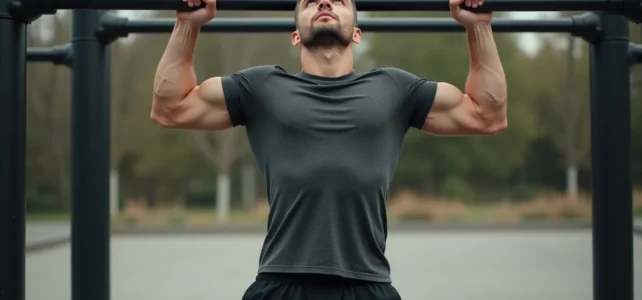
On a a park bar or in a gym, we regularly see practitioners effortlessly chaining pull-ups, while others struggle to complete even one. The average number of pull-ups among men directly depends on training level, body weight, and age, but the reality on the ground is harsher than one might think: the majority of untrained adults cannot perform a single strict pull-up.
Zero strict pull-ups: the real starting point for most men
Before discussing progression, it’s important to acknowledge a fact that online strength training programs often overlook. An inactive adult generally cannot perform a single clean pull-up. With arms extended in the low position, rising without momentum or kipping, chin above the bar: this complete movement requires a strength-to-body weight ratio that inactivity does not allow one to achieve.
Field reports converge: in a group fitness class or during a first gym session, most men who have never specifically worked on their upper body fail at the first repetition. We are indeed talking about pull-ups in pronation, hands forward, without a resistance band.
When looking at the average number of pull-ups among men who train regularly, commonly accepted benchmarks hover around 3 to 5 repetitions for an occasional practitioner. It’s low, but it’s already above the level of the general population.

Pull-ups and physical tests: the standards that set a benchmark
Entrance exams for the army, police, or firefighters use pull-ups as a selection test. These standards provide a much more reliable gauge than online surveys.
In these contexts, candidates are trained men, often for several months. Success thresholds vary by organization, but completing around ten strict pull-ups already places a candidate in a good zone. The best profiles far exceed this number, while some otherwise athletic candidates fail due to not having worked on this specific movement.
This gap between general fitness and pull-up performance is a point where feedback varies according to profiles: a lightweight long-distance runner and a rugby player do not approach the exercise with the same constraints. Body weight remains the most determining factor after back and arm strength.
Progressing in pull-ups: methods that work on the ground
We have tested, seen tested, and coached enough practitioners to know that three levers make a concrete difference.
Work on the negative phase of the movement
Jump onto the bar or use a bench, then slowly lower yourself while controlling the descent over several seconds. This eccentric phase strengthens the back muscles (latissimus dorsi, rhomboids) and the arms in the exact range of motion. Aim for 3 to 5 sets of slow descents, two to three times a week.
Resistance bands: a transition tool, not a crutch
Resistance bands attached to the bar relieve part of the body weight. The goal is to gradually reduce assistance over the sessions. A common trap: staying on the same band for weeks without ever testing without assistance.
- Start with a thick band that allows for 6 to 8 clean repetitions, then switch to a thinner band as soon as this number is easily achieved
- Alternate a session with a band and a session of negatives without assistance to force muscle adaptation
- Remove the band as soon as you can perform 2 to 3 strict pull-ups without assistance, even if the total number of repetitions drops
Training frequency and weekly volume
Three sessions per week dedicated to pull-ups are sufficient for progress without accumulating joint fatigue in the shoulders and elbows. Beyond that, the risk of tendonitis increases, especially in beginners whose tendons are not yet adapted.
An effective format: distribute the work into several short sets rather than a single set to failure. Five sets of 3 repetitions with 90 seconds of rest yield better results than a single set pushed to the max.

Strengthening auxiliary muscles to unlock pull-ups
The pull-up does not only engage the latissimus dorsi. The shoulders, forearms, and core play a direct role in the stability of the movement. Neglecting these auxiliary muscles creates a ceiling for progression.
- Inverted rows (body inclined under a low bar) prepare the back for the vertical pulling movement with less strain
- Bar hangs (dead hangs) strengthen grip and forearms, often the weak link in beginners
- Hollow body holds teach how to lock the pelvis during the pull-up, preventing swinging and energy waste
Strengthening grip and core eliminates the two main causes of stagnation in practitioners who plateau between 3 and 6 repetitions. We regularly see men capable of pulling their weight but unable to maintain a stable position beyond a few seconds.
Body weight and pull-ups: a variable often underestimated
Shedding a few kilos of body fat has a direct mechanical effect on the number of pull-ups. Each kilo lost represents a load removed at each repetition. At equal strength, a lighter practitioner will consistently perform more repetitions than a heavier practitioner.
This does not mean one must lose weight to do pull-ups. Gaining muscle in the back and arms more than compensates for a higher body weight. The decision is made on a case-by-case basis: an average-sized man who stagnates despite regular training often benefits from checking if his body composition is holding him back more than his actual strength level.
Progressing in pull-ups remains one of the most honest markers of functional upper body strength. Going from zero to one strict pull-up requires several weeks of targeted work. Moving from 5 to 10 typically takes longer, as each additional repetition costs proportionally more in strength and muscular endurance.