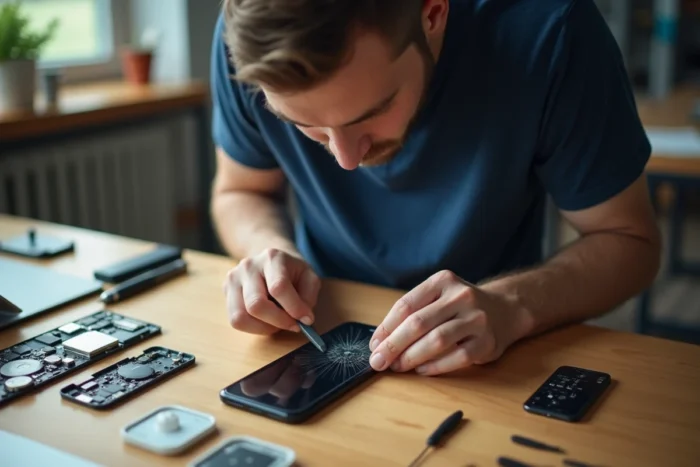
A smartphone sold in France typically lasts between two and three years before its owner replaces it. The main reason is not always an irreversible breakdown: a tired battery, a cracked screen, saturated storage, or software slowdowns often trigger a purchase.
However, recent European regulations, particularly the 2024/1799 directive on the right to repair, change the options available to extend the lifespan of a mobile phone. This framework requires manufacturers to provide spare parts and technical information for several years beyond the warranty, at a price deemed “reasonable.”
European directive on smartphone repair: what changes concretely
Content discussing smartphone longevity almost exclusively focuses on usage habits: avoiding heat, not completely discharging the battery, applying a protective film. While these tips remain valid, they overlook a regulatory shift that redistributes responsibilities among manufacturers, repairers, and users.
The 2024/1799 directive obliges manufacturers to offer repairs beyond the legal warranty. This means that a broken screen or a degraded battery no longer automatically justifies a device replacement. The manufacturer must make repairs accessible, with parts available and technical documentation open to independent repairers.
Starting February 18, 2027, another obligation comes into play: batteries must be removable and replaceable by the user. Glued batteries, which complicate any intervention without specialized tools, will become illegal on smartphones sold in the European Union. For individuals, this transforms battery replacement into a routine operation rather than a call to a technician.
On mobilejunky.fr, the technical sheets of recent devices already allow comparisons of disassembly ease and parts availability, two criteria that will increasingly weigh in the choice of a phone.

Battery digital passport: a still little-known diagnostic tool
The Ecodesign for Sustainable Products Regulation (ESPR) introduces a concept that does not yet exist in consumer habits: the product digital passport. This electronic document, associated with each device, will contain data on the battery’s composition, its aging state, and the smartphone’s repairability conditions.
For a repairer, this passport changes the game. Currently, assessing the actual state of a lithium-ion battery requires software diagnostics, often proprietary. The digital passport will standardize this information and make it accessible to all actors in the repair chain.
For a buyer of a refurbished phone, the benefit is direct: knowing the battery’s aging history before purchase reduces the risk of acquiring a device whose battery life will drop quickly. Field reports vary on this point, as the exact implementation conditions of the passport differ according to product categories and national timelines.
Smartphone repair vs replacement: the real decision criteria
The question of “repair or replace” cannot be resolved by a single price calculation. Several parameters come into play, and their weight varies depending on the breakdown.
- The cost of the part relative to the residual value of the device: a replaced screen on a mid-range model can represent half the price of an equivalent refurbished phone
- The actual availability of spare parts: some manufacturers still limit access to original components, even though the 2024/1799 directive aims to correct this situation
- The software state of the smartphone: a device that no longer receives security updates poses a problem that hardware repair does not solve
- The realistic remaining usage time after repair: replacing a battery on a phone whose processor struggles with current applications offers limited gains
Apple estimates a lifespan of about four years for its models, while Samsung estimates around three years. These figures reflect the period during which software support remains active. Without security updates, a repaired smartphone remains vulnerable, regardless of its hardware condition.
The trap of saturated storage
A slowdown perceived as a sign of hardware aging often stems from nearly full internal storage. Android and iOS systems use free space for cache and virtual memory. When this space drops below a certain threshold, performance noticeably declines.
Before considering a repair or replacement, clearing storage (cloud-synced photos, unused apps, forgotten downloaded files) can restore several months of smooth usage to a device. This diagnosis takes a few minutes and costs nothing.

Protecting your smartphone from avoidable breakdowns: actions that have a measurable impact
Not all protection advice is equal. Some are common sense (not immersing a non-waterproof phone), while others have a real and documented impact on component longevity.
Extreme temperatures accelerate the degradation of lithium-ion batteries. Leaving a smartphone in direct sunlight on a dashboard or using it while charging in a hot environment causes thermal stress that irreversibly reduces battery capacity. In contrast, moderate daily temperature variations (going from indoors to outdoors in winter) have no significant short-term effect.
Partial charging, between twenty and eighty percent, better preserves battery chemistry than complete cycles from zero to one hundred percent. Most recent smartphones now include an optimized charging feature that automatically limits the maximum level.
- Use a charger certified by the manufacturer or compliant with the USB Power Delivery standard, as inappropriate voltage degrades battery cells
- Enable optimized charging in the settings (available on iOS and most recent Android overlays)
- Periodically clean the charging port with a wooden toothpick or an anti-static brush, as compacted dust prevents contact and forces repeated reconnections
The combination of a case and tempered glass remains the most direct way to avoid screen repairs, which represent the most frequent and costly breakdown on most models.
The European regulatory framework, which is gradually coming into effect between 2026 and 2027, transforms smartphone repair from a voluntary choice into a structured right. Replaceable batteries, accessible parts, digital passports: these developments give users concrete levers to keep their device longer, provided they know when repair makes sense and when replacement becomes the only rational option.