
When considering committing to a woman who already has a child, the question goes beyond feelings. You are entering an existing family system, with its routines, attachments, and sometimes a biological father still present in the equation. Three concrete situations consistently arise in this context and deserve examination before any decision is made.
1. Active co-parenting with the biological father: a non-negotiable parameter
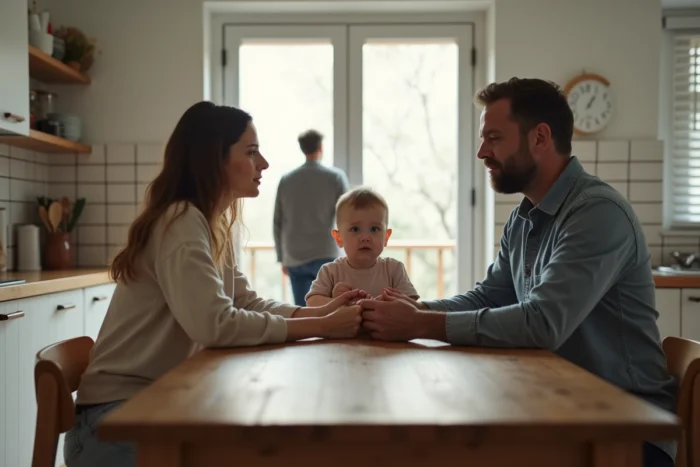
It is often assumed that the relationship involves just two people. In practice, when the child’s father exercises his visitation rights or shares custody, you find yourself dealing with a third adult whose decisions directly influence daily life. Weekend schedules, school holidays, educational choices: the biological father remains a permanent actor in the household.
French law reinforces this reality. In the event of a subsequent separation, the biological parent retains their financial obligations and parental authority. A new partner has, in principle, no legal status regarding the child, except through adoption or delegation of parental authority. You can live under the same roof as a child for five years and have no legal rights concerning them.
Before committing, it is beneficial to observe how co-parenting functions in practice. Several warning signs provide reliable signals:
- Are the exchanges between the two parents calm, or does every weekend of custody generate conflict that spills over into the couple?
- Are decisions regarding the child (schooling, health, activities) made in a structured framework or in emotional urgency?
- Does the biological father accept the presence of a new partner, or is he actively trying to destabilize the relationship?
Feedback varies on this point, but unresolved parental conflict between ex-partners complicates couple life in the long term. It is not a matter of goodwill: it is a structural framework that you either navigate or endure.
Detailed resources on this topic are available on the website www pointcontrepoint fr, which addresses the practical dimensions of this decision.
2. The child’s attachment: a bond that engages before the couple

The speed at which a child attaches to a new adult present in their daily life is often underestimated. Creating a bond with the child morally engages you long before signing a joint lease. Child protection professionals emphasize the importance of preventing disruptions in family pathways, and this logic also applies in private settings.
The Senate report on child protection highlights the need for a common culture around attachment. A child who has already experienced their parents’ separation often carries an increased sensitivity to abandonment. Entering their life and then leaving a few months later is not trivial.
Practically, this means that you should not meet the child too early in the relationship. Several months of exclusive time with the mother allow you to assess the strength of the couple before introducing an additional attachment figure. Meeting the child is already a form of commitment.
Once the bond is established, the question shifts from “do I want to be with this woman” to “am I ready to take on a stable role with this child.” This shift happens quickly, and many men realize it only afterward.
3. The blended daily life: balancing couple life and parental constraints

Life with a single mother is nothing like a relationship without children. Spontaneous outings, impromptu weekends, and free evenings become the exception. The household’s rhythm is dictated by the child’s needs: homework, meals, bedtime, extracurricular activities, medical appointments.
This is not a disadvantage in itself, but it is a reality that requires sincere adjustment. You cannot enter this configuration hoping that “it will adapt.” The adaptation must be anticipated, discussed, and, above all, desired.
Several recurring tensions appear in blended families:
- The role of the new partner in parenting: can they set rules, or do they remain a spectator? This ambiguity generates frustration on both sides.
- The financial management of the household: contributing to expenses related to a child who is not yours raises legitimate questions, especially in the absence of a clear legal framework.
- Couple time: without deliberate effort to preserve moments together, the relationship transforms into logistical teammates.
French law is evolving towards greater recognition of non-biological adults in the family. Parenthood is increasingly thought of in terms of functions and recognition, not just biological ties. An involved stepparent builds legitimacy through practice, even if the legal framework lags behind the realities on the ground.
Deciding to commit to a woman who has a child means accepting that the couple’s relationship will never be isolated from the rest. The choice is not between love and constraint, but between a consciously chosen family life and an idealization that does not withstand the first rainy Wednesday afternoon with a six-year-old child who refuses to do their homework.