
The Labrador Beauceron mix does not have an official standard, nor a pedigree recognized by the FCI or the SCC, yet this dog is attracting an increasing number of families. Crossing a Canadian retriever known for its docility with a French shepherd bred for guarding and herding produces puppies whose temperament is inherently difficult to predict. This genetic unpredictability is precisely what deserves to be examined before any commitment.
European Regulatory Framework and Crossbreeding of Dogs
Typical articles on this crossbreed focus on character and appearance, but a recent regulatory angle is changing the game. The Animal League has reported on a European reform aimed at better regulating breeding and limiting risky breeding practices for dogs and cats. The new guidelines are set to significantly restrict inbreeding, particularly between parents and offspring or between siblings.
For the Labrador Beauceron mix, this concretely means that litters from improvised family contexts, where two related dogs are bred without oversight, will be increasingly regulated. The available data does not yet allow for a precise measurement of the impact of these measures on the volume of mixed-breed puppies available for adoption, but the trend is clear: producing this type of dog outside a responsible framework will become legally more complicated.
This context encourages discovering on Ado PCJE the often-overlooked aspects of this crossbreed, particularly the traceability of the parents and the breeding conditions that affect the health of the puppies.
Genetic Variability of the Labrador Beauceron Mix: What Chance Decides
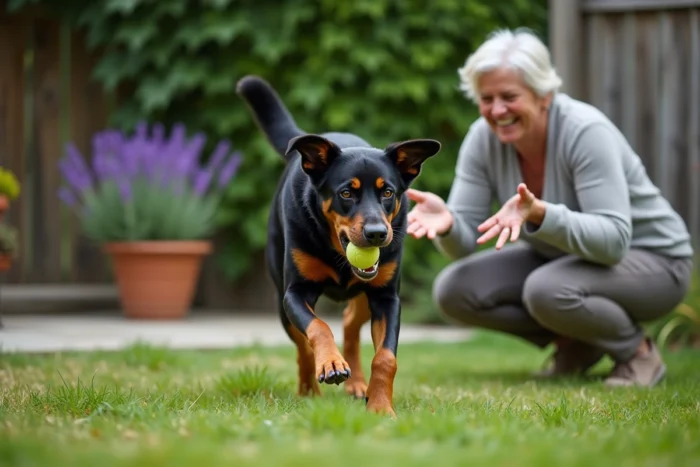
A purebred dog offers a relatively predictable range of behaviors. A first-generation cross between a Labrador and a Beauceron, on the other hand, produces individuals whose temperament oscillates between two very different poles. The Labrador brings its spontaneous sociability, tolerance towards strangers, and love for play. The Beauceron contributes a strong guarding instinct, natural suspicion, and a need for clear hierarchy.
Each puppy in the same litter can inherit a different mix of these traits. One individual may be as friendly as a purebred Labrador, while its littermate develops a territorial vigilance akin to the Beauceron. Field reports vary on this point: some owners describe a placid companion, while others report a dog that stands guard at the slightest unusual noise.
Consequences for Choosing a Puppy
Observing the parents remains the best available indicator. A serious breeder or individual will always agree to present the mother in situation, showing how she interacts with strangers and other animals. The father is sometimes absent, but having information about his temperament helps in anticipating.
- Check if the mother shows signs of overprotection or, conversely, a friendly sociability towards visitors
- Request the health history of both parents (hip dysplasia, eye problems, stomach torsion), documented pathologies in both breeds
- Observe the puppy in a new environment: its reaction to a sudden noise or an unfamiliar object gives clues about its reactivity threshold
None of these observations guarantees adult behavior, but they reduce the unknown factor.
Training the Labrador Beauceron: Managing Two Behavioral Logics
The Labrador learns quickly because it seeks to please. The Beauceron learns quickly because it understands the logic of an order. These two motivations are managed differently, and this is where many owners find themselves destabilized.
A Labrador-dominant mix will respond well to food reward-based methods. A Beauceron-dominant mix will need absolute consistency in the rules: if something is forbidden on Monday, it must remain forbidden on Sunday. Any inconsistency will be interpreted as a flaw in the hierarchy, which can lead to controlling behaviors (pulling on the leash, ignoring recalls, positioning itself physically between the owner and a third party).
Early Socialization and Physical Exercise
Socialization before four months shapes the majority of adult behaviors in this crossbreed. Exposing the puppy to varied environments (markets, transportation, presence of other pets) during this critical window significantly reduces the risks of later reactivity.
In terms of exercise, this medium to large-sized dog needs sustained daily physical activity. A simple walk is not enough. Activities that engage its scent or intelligence, such as tracking or advanced obedience, suit its profile better than mere running.

Health of the Labrador Beauceron Mix: Pathologies Inherited from Both Lines
The crossbreed does not automatically protect against genetic diseases. Both breeds share a predisposition to hip dysplasia, meaning the risk does not decrease in the mix; it may even accumulate if both parents are carriers.
- Hip and elbow dysplasia: common in both Labradors and Beaucerons, it warrants early radiographic screening
- Gastric dilatation-volvulus: the Beauceron is particularly prone to this due to its deep chest, a trait often passed on to the mix
- Eye problems: progressive retinal atrophy on the Labrador side, to be monitored from the early years
- Overweight: Labradors have a marked tendency towards obesity, exacerbated if daily exercise is insufficient
Regular veterinary follow-up with joint assessments from a young age can help anticipate most of these issues. Requesting the screening results of the parents before adopting remains the most effective precaution.
This crossbreed produces endearing dogs often remarkable for their versatility, provided that the buyer understands the commitment required. A well-socialized, properly stimulated, and medically monitored Labrador Beauceron mix can become a reliable companion for about ten years. The decisive factor is not genetics alone, but the quality of the environment the owner is willing to provide.